
You pasted a student’s name into ChatGPT to draft feedback faster. Maybe an IEP detail, a grade, a behavior note. It felt harmless — you were trying to help, and quicker. Here’s the question nobody hands you with the tool: was that legal?
I need to be straight with you, because most articles on this either wave it away or bury you in legalese. The short version: whether teachers can use ChatGPT with student data depends entirely on which version you’re using — and the free one you probably signed up for is the one that gets your school in trouble. This isn’t scare copy. It’s a specific, fixable problem, and I’ll show you exactly where the line is.
I don’t teach, but I coordinate clinical research at a hospital, where handling protected data correctly is the entire job. The rules that govern student records work almost identically to the ones I follow daily. So this is the one topic where my angle isn’t “researcher who read about it” — it’s “person who does data compliance for a living.”
The One Rule That Prevents Almost Every Violation
Never enter student personally identifiable information into a consumer-grade AI tool. That single sentence covers the overwhelming majority of teacher AI privacy questions, and it doesn’t require a law degree to follow.
Personally identifiable information — PII — means anything that identifies a specific student: their name, ID number, grade on a specific assessment, IEP or diagnosis details, or a description specific enough to point to one child. The moment that information leaves your school’s controlled systems and lands in a third party’s servers, you may have crossed a legal line — even if you had no idea, and even if your intentions were good.
The law here doesn’t care about intent. That’s the part teachers find hardest to accept. A privacy violation caused by pasting a student essay into a free AI tier is still a violation even if you never knew the data could be used for training. Good faith is not a defense the statute recognizes.
What FERPA Actually Says About This
FERPA — the Family Educational Rights and Privacy Act — protects student education records and applies to every institution receiving federal funding. In plain terms, it’s a “no disclosure without consent” law. You cannot hand a student’s education record to an outside party unless a specific exception applies.
Here’s the concrete example that makes it click. Suppose you type this into a consumer chatbot: “Maria, a 7th-grader at Lincoln Middle, scored 28% on her math benchmark and qualifies for the IEP review next week.” That prompt contains PII from an education record. Sending it to a third party without consent is a FERPA violation by the institution.
Notice who’s liable in that sentence. Not you, personally — the institution. And that’s the quiet trap in the whole situation, which I’ll come back to, because it changes who carries the risk you’re creating.
There are two legal exceptions that could permit AI use. One is specific, signed, dated parental consent naming the records, purpose, and recipient — which is wildly impractical for daily use. The other is the “school official” exception under FERPA. A common misconception is that this exception requires a written contract — it doesn’t, strictly speaking. What FERPA requires is that the vendor performs an institutional service or function, stays under the school’s direct control with respect to education records, and uses the data only for authorized purposes. A written agreement is still best practice, and state laws or district policies often do require one — but the FERPA test is about control and use, not paperwork alone.
Why the Free Tier Is the Real Problem
The distinction that matters is not the tool’s name — it’s the tier. The same brand can be safe or unsafe depending on which version you’re logged into, and this is where nearly every teacher goes wrong.
Free consumer tiers of general AI tools generally use your conversations to improve their models, unless a formal agreement explicitly forbids it. That means the student data you paste can become part of a training dataset — permanently, outside your school’s control, in a place no parent consented to. One security analysis put it bluntly: the companies legally own the training data they receive.
Compare that to education-tier deployments. Tools like ChatGPT Edu, Claude for Education, or Google Workspace for Education can be safe — but only when your institution has signed a Data Processing Agreement that prohibits training on your data and binds the vendor to FERPA terms. The tool didn’t change. The contract behind it did. That contract is the entire difference between compliant and not.
So the practical test is two questions, every time: Which tier am I on? And am I about to type something that identifies a student? If it’s a free tier and the answer to the second is yes — stop.
The Liability Trap Teachers Don’t See Coming
The institution carries the legal penalty, but you carry the professional fallout. This asymmetry is the part that should actually change your behavior, and almost no one explains it.
Walk through what happens if student data leaks through an AI tool. The vendor, in most cases, faces no FERPA penalty — they’re classified as a service provider with few obligations under a law written before this was possible. Your school, on the other hand, faces the violation, the penalties, and any lawsuits. One breakdown of the risk framed it as a liability asymmetry: if data leaks via an AI vendor’s bug, the vendor faces essentially zero FERPA penalty while the school faces the consequences per violation.
You are not the regulated entity, technically. But you are the person who pasted the data, and you’re the one who has to explain that to an administrator, a parent, or a district lawyer. “The tool made it easy” is not a conversation you want to have. The convenience was yours; the exposure is your school’s and, reputationally, yours.
What To Do Instead — Without Giving Up AI
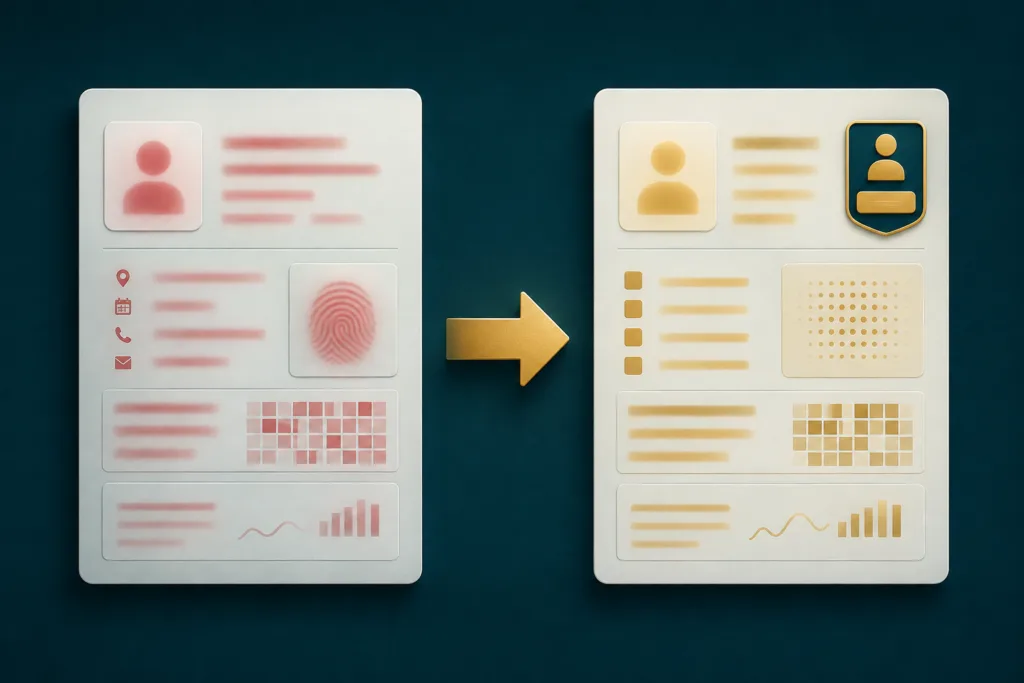
None of this means abandon AI. It means change one habit: strip the identity before the data ever reaches the tool. You can keep almost all the time savings while removing almost all the risk.
Here is the safe workflow, in order:
- De-identify first. Replace real names with “Student A,” drop the school name, remove ID numbers and specific diagnoses. “A 7th-grader scored 28% on a benchmark and needs an intervention plan” is a legal prompt. The same sentence with “Maria at Lincoln Middle” is not.
- Use the tier your district cleared. If your school has an education-tier agreement, use that account for anything approaching student data — not your personal login.
- Ask before you assume. If you don’t know whether your district signed a Data Processing Agreement, that’s a one-email question to your administrator. The answer determines what you’re allowed to do.
- Watch behavioral data too. Privacy isn’t only names. Detailed behavioral descriptions can identify a student as surely as an ID number. Treat them with the same caution.
There’s also good news the older articles miss. In late 2025, OpenAI launched ChatGPT for Teachers, a workspace with education-grade privacy aligned to FERPA that does not retain student data for model training, offered free to verified US educators. That doesn’t erase the need for your district’s sign-off, but it means a compliant path now exists that didn’t a year ago. Verify it against your own institution’s rules before trusting it with real data.
The Bottom Line for Your Classroom
Whether teachers can use ChatGPT with student data comes down to one honest answer: yes, but only after you de-identify the data or use a tier your institution has formally cleared. Everything else is risk you’re absorbing on your school’s behalf, usually without realizing it.
The reason I trust this framing is that it’s the same discipline I use with clinical data every day — you never rely on the tool being safe, you make the input safe before it ever gets there. Do that, and AI stays the time-saver it should be, without the part that could cost your school or your standing.
This fits into the larger picture of using AI well as a teacher, which I map out in the AI workflow for teachers guide, and it’s part of protecting your own energy and boundaries covered in the teacher burnout guide.
Sources
- FERPA and AI: Can Schools and EdTech Use ChatGPT With Student Data? — Sonomos (2026)
- Student-Safe AI Tools in 2026: What Teachers Need to Know — SchoollyAI
- FERPA in the Age of AI — DEV Community
- OpenAI launches ChatGPT for Teachers with FERPA compliance (2025)
- U.S. Department of Education — FERPA
This article is for general information, not legal advice. FERPA and district policies vary; consult your school administrator or legal counsel before adopting AI tools with student data.

Hi, I’m Marcos Antonio — a researcher with a deep passion for education and technology.
I created GrowthLane because I’ve seen firsthand the exhaustion that takes hold of so many teachers, and how few people talk about the ways out. I believe educators deserve more time, less burnout, and the freedom to build the next chapter of their own careers — and that artificial intelligence, used the right way, can make all of it happen faster.
Here you’ll find practical strategies to ease your workload with AI, recover from burnout, earn extra income, and — if you choose to — transition into a career beyond the classroom. No magic formulas. Just honest, tested advice, written for the real lives of the people who teach — and grounded in deep research on the subject.
When I’m not writing, you’ll find me exploring new tools, going for long walks, drinking too much coffee, playing online games, and spending time with my family — the greatest purpose of my life. I’m so glad you’re here. Let’s build a brighter path together.