
Series: The Teacher Time-Back System — Part 2
A teacher time audit is the step almost every productivity guide skips. The advice usually starts one stage too late: here is how to batch your grading, here is how to automate your parent emails, here is the app that will save you four hours. All of it assumes you already know where your hours go.
You probably don’t. Not because you aren’t paying attention — because of how human memory handles time.
I should be honest about the order here. Part 1 of this series gave you a system for sorting tasks into four buckets: automate, assist, keep human, stop doing. That system works. But it assumes an input I never told you how to get — an accurate list of what you actually do. This article is the missing step, published second and belonging first.
The measurement problem nobody mentions
I read research for a living. My job involves looking at whether a study measured what it claims to have measured, and self-reported time is one of the messiest variables in social science. That is the whole reason a teacher time audit needs a method rather than a moment of reflection.
Here is the finding that should change how you approach this. In 1994, John Robinson and Ann Bostrom compared what American workers said they worked with what those same workers recorded in detailed time diaries. The estimates were consistently higher than the diaries. More importantly, the error was not random: the longer the workweek someone claimed, the larger the gap. People reporting 40 to 44 hours overestimated by roughly two hours. People reporting 55 to 59 hours overestimated by around ten.
Robinson and colleagues revisited this in 2011 using American Time Use Survey data and found the same shape, though more modest — overestimates in the range of 5 to 10 percent, concentrated among people claiming the longest weeks.
Now hold that next to the teacher data. RAND’s 2025 State of the American Teacher survey found teachers reporting 49 hours per week against roughly 39 contracted hours. That is a ten-hour gap, and teachers sit exactly in the range where the estimate error is largest.
Where I have to be careful
This is the part most blog posts would skip, and skipping it would make the argument look stronger than it is.
The overestimation finding is contested. Jerry Jacobs argued in 1998 that the gap is mostly regression to the mean — people who happened to work an unusually long week before being surveyed naturally worked closer to normal during the diary day. Harley Frazis and Jay Stewart, analyzing ATUS data, found little meaningful difference between diary and estimate figures.
Robinson’s counterargument is that the size of the gap has changed over decades — 1.3 hours in 1965, 6.2 hours in 1985, 2.4 hours in the 2003–07 period — and a pure statistical artifact shouldn’t drift like that. His explanation is that as work schedules became more irregular, with no clock to punch, people lost the anchor points that make estimation possible.
So what should you take from a genuine scientific disagreement?
Not “teachers don’t really work that much.” That reading would be both wrong and insulting. The gap between contracted and actual hours is real and well documented, and even the skeptics agree teachers work far beyond their contracts.
Take this instead: your global sense of your week is a perception, not a sum. It is built from salient moments, not from addition. And that is enough to justify measuring instead of guessing, regardless of which side of the academic dispute turns out to be right.
There is a second reason the irregularity argument matters for teachers specifically. Teaching has more schedule irregularity than almost any office job — a free period consumed by a parent call, a prep block eaten by covering someone’s class. Those are precisely the conditions Robinson identified as destroying accurate estimation.
Why the five-day diary is the wrong prescription
The methodologically correct answer is a time diary: record activities as they happen, in near real time, for at least five working days. That is what researchers do, and it produces the best data available short of direct observation.
I am not going to recommend it to you.
A burned-out teacher will not carry a logging sheet through five days of teaching. The compliance problem is well known in research — even paid study participants find diaries burdensome, and the more overloaded someone is, the more likely they are to abandon the protocol. If I gave you the rigorous method, the most probable outcome is that you’d start on Monday, miss Wednesday, and conclude you’re bad at this.
A worse method you complete beats a better method you abandon.

How to run a teacher time audit in 20 minutes
The method below borrows from something real. In 2004, Kahneman, Krueger, Schkade, Schwarz, and Stone published the Day Reconstruction Method in Science — a technique built to approximate real-time sampling while asking far less of participants. Rather than asking a global question, the DRM asks people to rebuild the previous day as a sequence of discrete episodes, like scenes in a film, each with a start and end time.
That episode framing is the active ingredient. Reconstructing specific, bounded scenes pulls concrete memories instead of general beliefs, and the original study found this produced patterns closely matching real-time sampling — including a counterintuitive V-shaped daily tiredness curve that participants would never have produced from general beliefs about themselves.
You are going to do a compressed version of that, using documents instead of memory wherever possible.
Set a timer for 20 minutes. Pick the most recent normal week. Not the week of parent conferences, not the week you were out sick.
Step 1 — Open your evidence, not your memory (5 minutes). Pull up your calendar, your sent email folder, your messaging app, and your grading platform, each filtered to that week. These are timestamped records that don’t flatter anyone. Sent-email timestamps are especially revealing: they show when you were actually working, including the 9:40 p.m. replies you’ve stopped noticing.
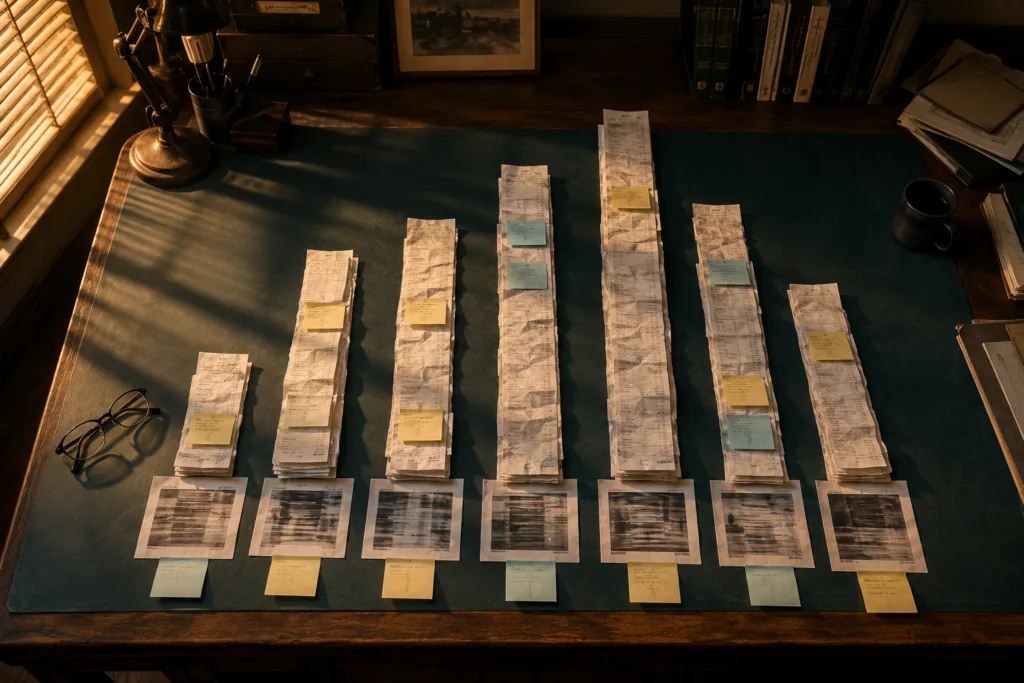
Step 2 — Rebuild the week as episodes (10 minutes). Go day by day, writing bounded scenes with rough start and end times. “7:10–7:45, arrived early, printed and prepped materials.” “3:30–4:15, covered duty, answered three parent emails.” Aim for chunks of 15 minutes to 2 hours. Do not categorize yet — categorizing while recalling makes you reach for the tidy answer.
Step 3 — Tag each episode (5 minutes). Now label each one: Teaching (instruction and direct student interaction), Prep (planning, materials, setup), Assessment (grading and feedback), Admin (forms, data entry, compliance, meetings), Communication (parents, colleagues, administration), and Invisible — the category that matters most. Invisible work is what appears on no job description and no contract: the hallway conversation with a struggling student, the colleague who needed ten minutes, the mental load of a behavior situation you carried home.
Add the tagged hours. Then write down what you would have guessed before starting, and compare.
What the number is actually for
The gap between your guess and your reconstruction is diagnostic information, not a verdict on your character.
If your reconstruction came in lower than your guess, that is the expected direction and it means nothing bad about you. It means your sense of the week was built from its heaviest moments. That is how memory works, and the moments were still heavy.
If your reconstruction came in higher, look at the Invisible column. That is usually where the extra hours are hiding, and it is the strongest argument you have when someone suggests you simply manage your time better.
What you now have that you didn’t before is a distribution rather than a total. Twelve hours of assessment and three of admin is a completely different problem from three of assessment and twelve of admin, and it points toward completely different solutions. Total hours tell you that you’re tired. The distribution tells you what to do about it.
The honest limits of what you just did
Three things this teacher time audit will get wrong, and you should know all of them:
It will undercount fragmented work. Time diaries are known to miss short-duration activities, and reconstruction misses them worse. The two-minute interruptions — a question between classes, a quick email check — are the hardest thing to recover and, in aggregate, often substantial. Whatever your fragmentation number looks like, treat it as a floor.
It will be shaped by what’s documented. Work that leaves a timestamp is easier to recover than work that doesn’t, which biases against exactly the invisible labor you most want to see. That is why Invisible gets its own tag rather than being folded into an “other” bucket.
It is one week, not your average week. A single sample of a variable thing. If the week you picked turns out to be unrepresentative, that is a genuine limitation, not a reason to distrust the whole exercise. Run it again in a month if you want something closer to a real average.
None of this makes the exercise worthless. It makes it measured — which is a different and better thing than certain.
Where this goes next
Take your tagged list back to the four-bucket system in Part 1. Now that sorting exercise has real input: your actual Admin and Communication episodes are the strongest candidates for automation, your Teaching and Invisible episodes are almost always the ones to protect, and your Assessment episodes usually split between the two.
And if the reconstruction shows that your week is structurally overloaded rather than inefficiently arranged — if the hours are going to work the job genuinely requires, not to waste — then no workflow tool is going to fix that. That’s a different conversation, and it’s the one our guide to teacher burnout is for.
You can’t negotiate with a number you don’t have. Start there.
Sources
- Robinson, J. P., & Bostrom, A. (1994). “The overestimated workweek? What time diary measures suggest.” Monthly Labor Review, 117(8), 11–23. Full issue — FRASER, St. Louis Fed
- Robinson, J. P., Martin, S., Glorieux, I., & Minnen, J. (2011). “The overestimated workweek revisited.” Monthly Labor Review, June 2011. U.S. Bureau of Labor Statistics
- Kahneman, D., Krueger, A. B., Schkade, D. A., Schwarz, N., & Stone, A. A. (2004). “A Survey Method for Characterizing Daily Life Experience: The Day Reconstruction Method.” Science, 306(5702), 1776–1780. Science
- Steiner, E. D., Woo, A., & Doan, S. (2025). Teacher Well-Being, Pay, and Intentions to Leave in 2025. RAND Corporation. RAND
- Steiner, E. D., Levine, P. R., & Doan, S. (2026). Teacher Well-Being, Pay, and Intentions to Leave in 2026. RAND Corporation. RAND
This article discusses workload and wellbeing in general terms and is not medical or mental health advice. If you are experiencing persistent exhaustion, low mood, or distress, please speak with a qualified healthcare professional.

Hi, I’m Marcos Antonio — a researcher with a deep passion for education and technology.
I created GrowthLane because I’ve seen firsthand the exhaustion that takes hold of so many teachers, and how few people talk about the ways out. I believe educators deserve more time, less burnout, and the freedom to build the next chapter of their own careers — and that artificial intelligence, used the right way, can make all of it happen faster.
Here you’ll find practical strategies to ease your workload with AI, recover from burnout, earn extra income, and — if you choose to — transition into a career beyond the classroom. No magic formulas. Just honest, tested advice, written for the real lives of the people who teach — and grounded in deep research on the subject.
When I’m not writing, you’ll find me exploring new tools, going for long walks, drinking too much coffee, playing online games, and spending time with my family — the greatest purpose of my life. I’m so glad you’re here. Let’s build a brighter path together.