
Teacher Burnout: 7 Proven Ways AI Can Reclaim Your Time
You didn’t become a teacher for the paperwork.
You became a teacher for the lightbulb moments — the student who finally gets it, the quiet kid who starts raising their hand, the irreplaceable work of helping someone grow.
But somewhere between the lesson plans you write at 10 p.m., the grading stack that never shrinks, and the emails that follow you home, that spark starts to flicker. That slow fade has a name: teacher burnout.
If you’re exhausted, you’re not weak, and you’re not alone. Teacher burnout is now one of the most documented crises in education — and the data is staggering.
Here’s the hopeful part. For the first time, there’s a tool that can genuinely hand some of your hours back: artificial intelligence. Not to replace you — to protect you.
This post is the front door to everything GrowthLane stands for: recovering from burnout, reclaiming your time with AI, and, if you choose, building a path beyond the classroom. Let’s start with the truth about how you’re feeling.
What the teacher burnout data really shows
It helps to know the exhaustion isn’t in your head. It’s measurable, and major research institutions have tracked it for years.
According to RAND’s 2025 State of the American Teacher survey, 53% of K–12 teachers reported feeling burned out. That’s down from 60% the year before — but still most of the profession.
Teachers are also nearly twice as likely to face frequent job-related stress as the average working adult. The pattern behind teacher burnout is consistent across every major study.
The workload gap explains a lot. Most teaching contracts call for 21–40 hours per week. Yet the large majority of teachers report working 41 to 80+ hours.
That extra time — often 10+ hours a week — gets swallowed by tasks far from the part you love: documentation, reporting, and planning no one budgeted for.
And teacher burnout isn’t only a U.S. story. In the UK, the National Education Union reported that three in four teachers had considered leaving in the previous year. A 2025 study of nearly 5,000 Australian teachers found 90% reported moderate to severe stress.
If those numbers feel familiar, take a breath. Recognizing the pattern is the first step out of it.
What teacher burnout actually looks like
Burnout isn’t just a bad week. It’s a slow accumulation — and researchers consistently identify three signs.
The three faces of burnout
- Emotional exhaustion — drained before the day begins, with nothing left for the people you love at home.
- Depersonalization — growing cynical or numb toward students and colleagues you used to connect with.
- A reduced sense of accomplishment — the creeping feeling that nothing you do is ever enough.
Here’s what most “self-care” advice misses: you can’t bubble-bath your way out of a workload problem.
Telling an exhausted teacher to “just relax more” ignores the real cause of teacher burnout. There are only so many hours, and too many are eaten by repetitive tasks.
That’s exactly where the right tools change the equation.
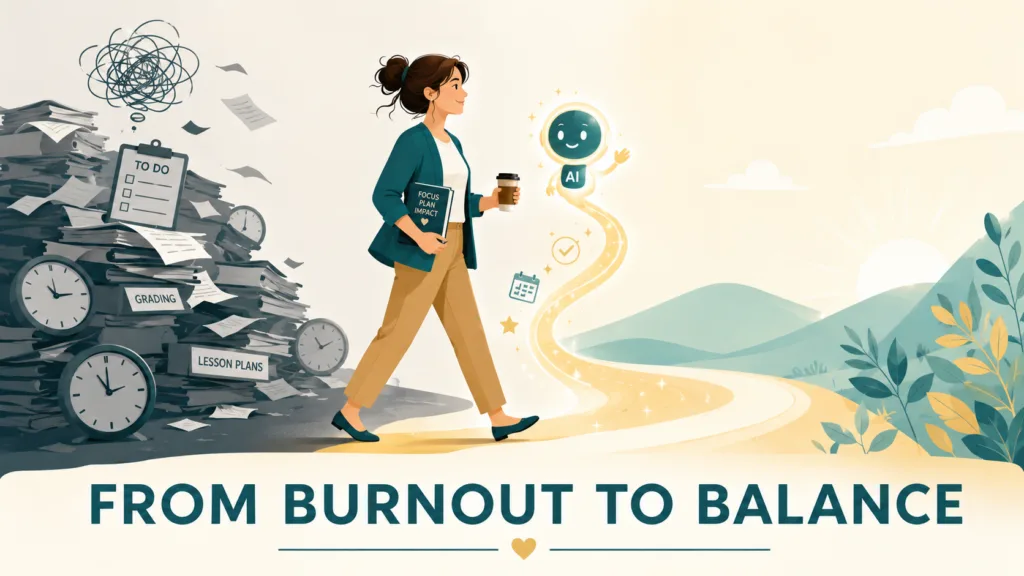
How AI helps reduce teacher burnout and give your hours back
Let’s be clear about what AI is and isn’t. It is not here to teach your students, replace your judgment, or write the parts of the job that need your heart.
Used well, AI is a support system for the repetitive, draining work that happens around teaching — the prep, the paperwork, the first drafts.
And the time savings are real. Studies and real-world programs find that teachers using AI for routine tasks save around five to six hours per week.
The UK’s government-backed Oak National Academy ran AI tools for lesson planning and quiz creation. Teachers there reported saving up to five hours weekly — time that went back into real student interaction.
Five hours a week is roughly six full weeks a year. Imagine getting six weeks of your life back.
Here’s where AI can carry the load.
1. Lesson planning and first drafts
Instead of staring at a blank page, ask an AI tool to generate a standards-aligned lesson framework in seconds — then shape it with your expertise.
The AI does the scaffolding; you do the teaching. Try this prompt: “Create a 45-minute lesson outline for [grade] students on [topic], with a warm-up, main activity, and exit ticket.”
2. Grading support and feedback drafts
AI can draft feedback comments, spot patterns across a stack of assignments, and handle the first pass on objective questions — while you keep the final say.
Most teachers using AI this way report real time savings, without handing academic judgment to a machine.

3. Parent and admin communication
The polite-but-firm parent email. The progress-report summary. The newsletter blurb. These small tasks add up to hours.
AI produces a solid first draft in seconds. You simply review and personalize it.
4. Differentiation for diverse learners
Adapting one worksheet into three reading levels used to mean triple the work. Teachers report AI makes differentiation dramatically faster.
You meet every student where they are — without staying until dark.
A responsible rule of thumb against teacher burnout: let AI handle the first draft and the routine; you keep the relationships, the judgment, and the final word.
When reclaiming time isn’t enough
For some teachers, lighter workloads are exactly what’s needed to fall back in love with the job. That’s a wonderful outcome, and much of GrowthLane exists to make it happen.
But let’s be honest. For others, the exhaustion runs deeper, and the question shifts from “How do I survive this year?” to “Is this still the right path for me?”
If that’s you, hear this clearly: wanting a change doesn’t make you a failure.
The skills you’ve built are extraordinary and in demand — communication, project management, breaking down complex ideas, managing a room, designing learning experiences.
Former teachers move into instructional design, corporate training, curriculum development, and remote education roles every day. Often with more flexibility and better pay.
And here’s what almost no one talks about: AI can accelerate that transition, too.
It can translate your classroom experience into corporate language, help you build a portfolio faster, and teach you the tools of a new field on your own schedule.
That intersection — using AI to escape teacher burnout and build a life beyond the classroom — is exactly what this blog helps with.
You don’t have to decide today. You just have to know the door exists.
Your next step starts here
Burnout thrives on the feeling that nothing can change. But something already is changing — you’re here, looking for a better way. That matters more than you think.
Here’s where to begin:
- If you need to recover first: pick one repetitive task this week — planning, feedback, or parent emails — and hand the first draft to an AI tool. Just one. Notice the time you get back.
- If you’re curious about AI tools: explore the Reclaim section for practical, classroom-tested guides.
- If you’re dreaming of a different path: the Escape section offers honest, step-by-step guidance on moving beyond the classroom with AI as your accelerator.
You became a teacher to change lives. Let’s make sure yours is one of them.
Sources
- RAND Corporation, State of the American Teacher Survey (2024 & 2025 data)
- Gallup / Walton Family Foundation, teacher wellbeing data (2025)
- National Education Union (UK), teacher retention data (2025)
- UNSW Sydney, Australian teacher stress study (2025)
- Oak National Academy (UK), AI workload reduction results
- NCTQ research on teacher time and workload (2025)
This article is for general informational and educational purposes only and does not constitute mental health, medical, or career advice. If you are struggling with your mental health, please reach out to a qualified professional.

Hi, I’m Marcos Antonio — a researcher with a deep passion for education and technology.
I created GrowthLane because I’ve seen firsthand the exhaustion that takes hold of so many teachers, and how few people talk about the ways out. I believe educators deserve more time, less burnout, and the freedom to build the next chapter of their own careers — and that artificial intelligence, used the right way, can make all of it happen faster.
Here you’ll find practical strategies to ease your workload with AI, recover from burnout, earn extra income, and — if you choose to — transition into a career beyond the classroom. No magic formulas. Just honest, tested advice, written for the real lives of the people who teach — and grounded in deep research on the subject.
When I’m not writing, you’ll find me exploring new tools, going for long walks, drinking too much coffee, playing online games, and spending time with my family — the greatest purpose of my life. I’m so glad you’re here. Let’s build a brighter path together.