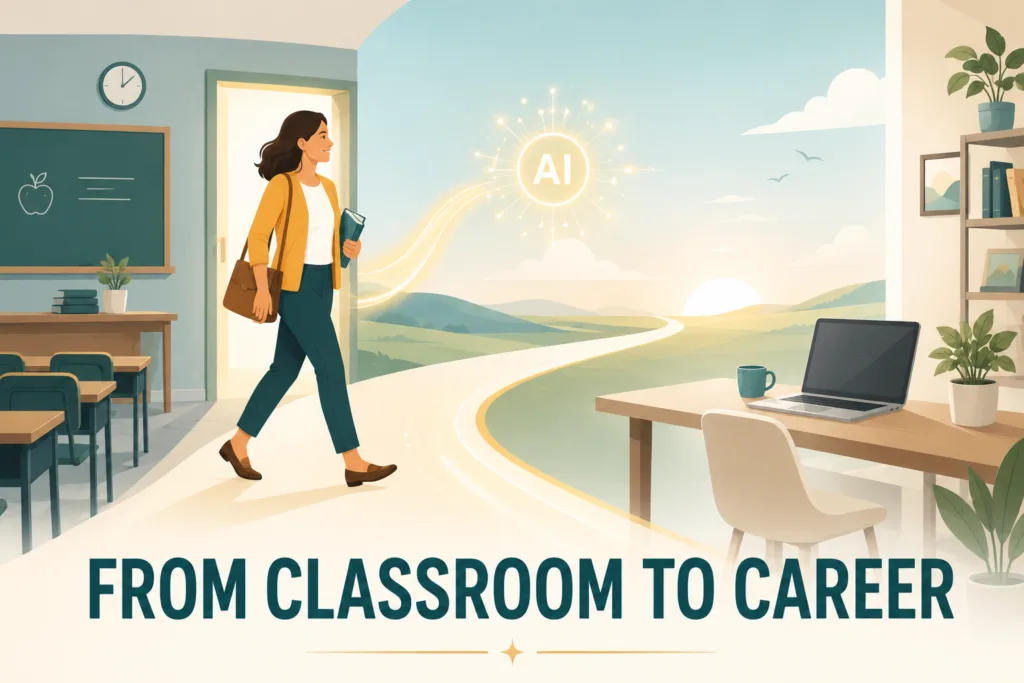
You spent years helping other people build their futures. Here’s how to build yours — without starting from zero.
There’s a quiet question many educators carry home at the end of the day: what else could I do?
If you’ve asked it, you’re in good company — and contemplating a career change for teachers is not a betrayal of the work you’ve done. It’s a recognition that your skills are worth more than the system sometimes gives back.
Here’s what almost no one tells you. The hardest part of leaving the classroom isn’t a lack of options. It’s not knowing how to translate what you already do into language the corporate world understands.
That’s exactly where AI changes the game. Used well, it can compress months of guesswork into weeks — helping you reframe your experience, build proof of your skills, and land interviews faster.
This guide walks through seven realistic remote roles, what they pay, and how AI can accelerate your move into each one. No fantasy. Just a clear-eyed map.
Why a career change for teachers makes sense right now
Let’s start with the truth that makes this whole conversation worth having: employers want what teachers have.
The skills you’ve built — communication, breaking down complex ideas, managing a room, designing learning experiences, staying calm under pressure — are in genuine demand across industries.
The numbers back it up. One job board tracking roles for former educators listed over 1,100 active positions with an average salary near $100,000, spanning instructional design, learning and development, and product roles.
A career change for teachers also tends to come with something the classroom rarely offers: flexibility. Many of these roles are fully remote, with schedules not bound to a school bell.
And demand is structural, not a fad. The U.S. Bureau of Labor Statistics projects steady growth for instructional design roles over the coming years, as companies keep investing in training their people.
How AI accelerates your transition
Before the role-by-role map, understand the engine. AI won’t get you hired on its own — but it removes the two biggest bottlenecks every career changer hits.
Bottleneck 1: Translating your experience
The most common mistake teachers make is writing a résumé that reads like an apology — leading with what they’re leaving instead of what they bring.
Career-switch experts are blunt about this: your professional narrative should position you as a “domain expert with new skills,” not a “former teacher trying to become something else.”
AI is remarkably good at this reframing. Feed it your teaching responsibilities and ask it to rewrite them in corporate language for a specific target role. “Managed a classroom of 30” becomes “led daily operations for a 30-person learning environment with measurable outcomes.”
Bottleneck 2: Building proof faster
In 2026, transferable skills alone are rarely enough. Employers want evidence — a portfolio, a sample project, proof you can do the new job.
This used to take months. AI shortens it dramatically: it can help you draft a sample e-learning storyboard, outline a training module, or structure a project that shows your new skills in action.
A responsible note: the goal isn’t to let AI think for you. As industry guides stress, what matters in interviews is being able to explain how AI supported your process — not hiding behind it.
7 remote jobs for a successful career change
Here are seven realistic paths, with honest pay ranges and how AI speeds your entry into each.
1. Instructional Designer
The most popular landing spot for ex-teachers — and for good reason. You design learning experiences for companies instead of classrooms, using the exact instincts you already have.
It’s also the role most success stories revolve around: educators who repackaged their classroom expertise and moved into corporate or tech teams, often fully remote.
Pay typically starts around $50,000–$65,000 and senior roles can exceed $100,000. AI accelerator: use it to build your first portfolio piece — a storyboard or module — without waiting for a course to hand you one.
2. Corporate Trainer / Facilitator
If you love the live, in-front-of-people part of teaching, this keeps it — for adult professionals, often with better hours and pay.
AI accelerator: generate training outlines and facilitation guides in minutes, so you can show a sample workshop in interviews.
3. Curriculum Developer
Designing structured learning programs is something teachers already do daily. Companies and edtech firms pay well for it.
AI accelerator: draft scope-and-sequence documents and learning objectives, then refine them with your expertise.
4. Learning & Development (L&D) Specialist
You help a company’s employees grow — onboarding, upskilling, training programs. It’s teaching, aimed at a workforce.
AI accelerator: research industry-specific training needs and draft program frameworks far faster than starting blank.
5. E-Learning Specialist
Focused on online training — webinars, interactive modules, on-demand content. Salary ranges often sit around $55,000–$80,000.
AI accelerator: speed up content creation and storyboard drafts so your portfolio shows range.
6. Educational Content Writer
If writing is your strength, companies and edtech brands need people who explain things clearly. Teachers excel here.
AI accelerator: use it as a drafting partner and editor — but keep your authentic voice as the final layer.
7. Education Consultant
Advise schools, edtech companies, or training teams using your classroom expertise — often as a flexible or independent path.
AI accelerator: build proposals, frameworks, and client-facing materials quickly to launch your own offer.
Your first three steps this week
You don’t need to quit tomorrow. A career change for teachers works best as a deliberate sequence, not a leap.
- Pick one role. Choose a single target from the seven above — not three. Focus turns a vague wish into a plan.
- Reframe one document. Take your current résumé and ask an AI tool to rewrite it for that specific role, leading with strengths, not apologies.
- Build one proof piece. Use AI to help you create a single portfolio sample for your target role. One strong sample beats none.
That’s it. Three steps, one week. The door out of the classroom isn’t a cliff — it’s a path you can walk one deliberate step at a time.
You’re not starting over — you’re starting from experience
Here’s the reframe worth holding onto: a career change for teachers isn’t throwing away years of work. It’s repackaging extraordinary skills for a market that values them.
Thousands of educators make this move every year, and the ones who succeed share one trait — they stop apologizing for their background and start leading with it.
AI is the accelerator that makes the move faster and less lonely than it’s ever been. But the expertise being repackaged? That’s all yours.
You spent your career opening doors for other people. It’s okay to open one for yourself.
Sources
- Edtech.com, Former Teacher Jobs board (June 2026 data: 1,132 active jobs, avg. salary $100,875)
- Devlin Peck, Best Jobs for Former Teachers and How to Become an Instructional Designer (2026)
- Research.com, Instructional Design Salary by Experience Level (2026)
- U.S. Bureau of Labor Statistics, employment outlook for instructional design roles
- IABAC, How to Switch to an AI Career (2026)
- ElevatED Careers, Training & Development Jobs for Transitioning Teachers
This article is for general informational and educational purposes only and does not constitute career, financial, or legal advice. Salary ranges are estimates and vary by location, experience, and employer.

Hi, I’m Marcos Antonio — a researcher with a deep passion for education and technology.
I created GrowthLane because I’ve seen firsthand the exhaustion that takes hold of so many teachers, and how few people talk about the ways out. I believe educators deserve more time, less burnout, and the freedom to build the next chapter of their own careers — and that artificial intelligence, used the right way, can make all of it happen faster.
Here you’ll find practical strategies to ease your workload with AI, recover from burnout, earn extra income, and — if you choose to — transition into a career beyond the classroom. No magic formulas. Just honest, tested advice, written for the real lives of the people who teach — and grounded in deep research on the subject.
When I’m not writing, you’ll find me exploring new tools, going for long walks, drinking too much coffee, playing online games, and spending time with my family — the greatest purpose of my life. I’m so glad you’re here. Let’s build a brighter path together.