

Some mornings the alarm feels heavier than it used to. The job you once loved now drains you before first period even starts.
If you’ve been wondering whether what you’re feeling is “just tiredness” or something more, this is worth a few minutes. Naming it is the first step toward changing it.
Teacher burnout symptoms rarely arrive all at once. They build quietly, over months, until one day the exhaustion feels like part of who you are. The good news: once you can recognize the signs, you can respond to them.
Let’s walk through what burnout actually is, the symptoms to watch for, and what they mean for you.
What teacher burnout actually is
Burnout isn’t a personal weakness or a bad attitude. It’s a recognized response to prolonged stress.
The World Health Organization includes burn-out in its International Classification of Diseases (ICD-11) as an “occupational phenomenon” — a syndrome resulting from chronic workplace stress that hasn’t been successfully managed. Notably, the WHO ties burnout specifically to the work context, not to life in general.
That distinction matters. Your exhaustion isn’t a flaw in your character. It’s a predictable result of demands that outran your resources for too long.
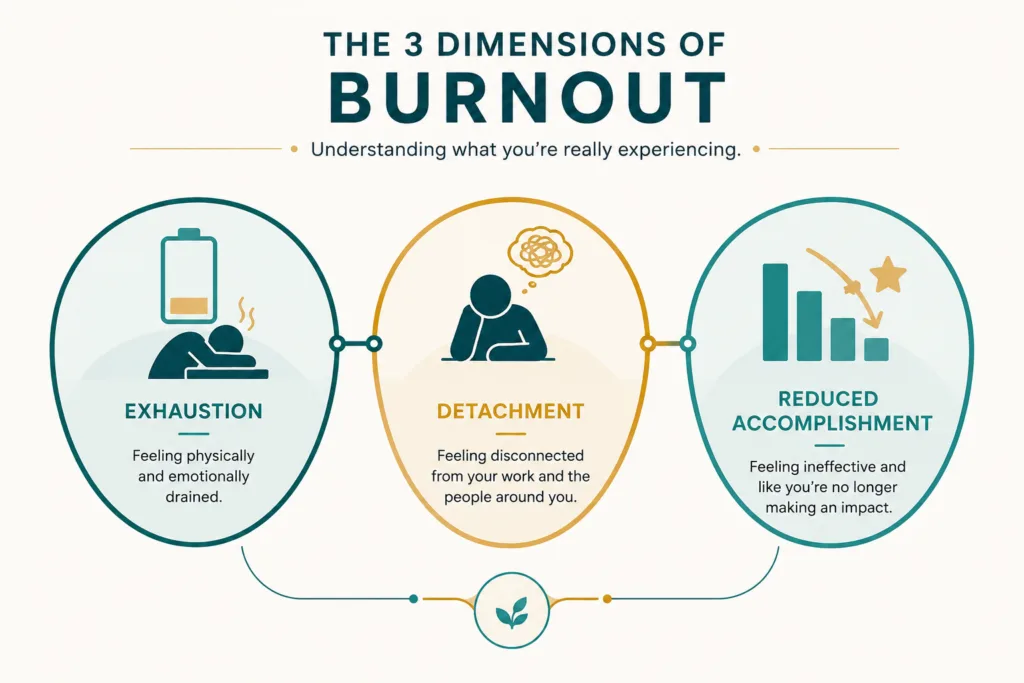
The 3 core dimensions of burnout
Decades of research — much of it built on the work of psychologist Christina Maslach — describe burnout across three connected dimensions. Most teacher burnout symptoms fall into one of these three buckets.
1. Emotional exhaustion
This is the core of burnout: feeling drained, depleted, and unable to recover even after rest. Researchers describe it as a loss of energy and chronic fatigue — the sense that you have nothing left to give.
For teachers, it often shows up as walking in the door at home with nothing left for the people you love.
2. Depersonalization (cynicism)
This dimension is about growing distant. It looks like negativity, cynicism, or a detached, “going through the motions” response toward students and colleagues you used to genuinely connect with.
It’s not who you are — it’s a protective shell that chronic stress builds.
3. Reduced sense of accomplishment
The third dimension is the quiet, creeping belief that nothing you do is good enough — a decline in your felt sense of competence and impact, even when you’re objectively still doing good work.
12 teacher burnout symptoms to watch for
Symptoms tend to cluster in three areas: emotional, physical, and behavioral. Here are twelve common signs. You don’t need all of them to be burning out — a persistent handful is enough to pay attention.
Emotional symptoms
- Constant dread about going to work, even on Sunday evenings.
- Irritability with students, colleagues, or family over small things.
- Emotional numbness — feeling detached or “flat” where you used to feel invested.
- A sense of failure that lingers no matter what you accomplish.
Physical symptoms
- Fatigue that sleep doesn’t fix — waking up already tired.
- Frequent headaches, tension, or stomach issues with no clear cause.
- Changes in sleep — insomnia, or sleeping far more than usual.
- Getting sick more often as chronic stress wears down your immune system.
Behavioral symptoms
- Withdrawing from colleagues, friends, or activities you used to enjoy.
- Procrastinating on tasks that once felt manageable.
- Using food, screens, or other escapes to numb out after the day.
- Counting down constantly — to the weekend, the break, the end of the year — just to get through.
If several of these feel uncomfortably familiar, you’re not imagining it, and you’re far from alone. Burnout is one of the most documented stress problems in the teaching profession.
Why “just rest” usually isn’t the answer
Here’s where many teachers get stuck. They assume the fix is more sleep or a longer break. Rest matters — but if the symptoms come from chronic, unmanaged workload, rest alone treats the surface, not the cause.
Think of it this way: a weekend recharges the battery, but if the same drain is waiting Monday morning, you’re back where you started by Wednesday. Real relief comes from changing what’s draining you, not just pausing it.
That’s the difference between coping with burnout and actually recovering from it.
What to do if these symptoms sound familiar
Recognizing the signs is genuinely the hardest part — and you’ve just done it. Here’s where to go from here.
- Take it seriously, early. Burnout has a trajectory. The sooner you name it, the easier it is to interrupt before it deepens.
- Protect one boundary. Pick a single limit — a hard stop time, no email after dinner — and hold it. One real boundary beats ten good intentions.
- Remove a repetitive drain. A huge share of teacher exhaustion comes from repetitive tasks. Handing the first draft of planning, grading, or parent emails to an AI tool can reclaim hours each week — and learning to reclaim your time with AI is one of the most practical ways to lighten the load.
- Understand why rest isn’t enough. If you’ve ever returned from a break only to feel the dread creep back, it helps to understand why rest alone isn’t enough — and what actually breaks the cycle.
- Reach out. If the emotional symptoms are heavy or persistent, talking to a doctor, counselor, or your employee assistance program isn’t a last resort — it’s a smart early step.
When symptoms point to a bigger question
For some teachers, easing the workload is enough to fall back in love with the job. For others, the symptoms keep pointing to a deeper question: is this still the right path for me?
If that’s where you are, wanting a change doesn’t make you a failure — and the skills you’ve built are in real demand elsewhere. Many former teachers build a path beyond the classroom, often with more flexibility and better pay. You don’t have to decide today. You just have to know the door exists.
You named it — that’s the turning point
Teacher burnout symptoms are your mind and body signaling that something needs to change. They’re not a verdict on your worth as an educator.
The teachers who recover aren’t the ones who push through hardest. They’re the ones who notice the signs early and respond — with boundaries, with lighter systems, and with honesty about what they need.
You’ve spent your career paying attention to everyone else. Today, that attention turned toward you. That’s exactly where recovery begins.
Frequently asked questions
What are the first signs of teacher burnout?
The earliest signs are usually emotional and physical: persistent dread about work, fatigue that rest doesn’t fix, and growing irritability or detachment. These tend to appear before the more visible behavioral signs like withdrawing or procrastinating.
Is teacher burnout the same as depression?
No. Burnout is tied specifically to the work context, while depression affects all areas of life. They can overlap and share symptoms, though — which is why persistent or heavy symptoms are worth discussing with a qualified professional.
Can you recover from teacher burnout without leaving teaching?
Often, yes. Many teachers recover by changing what drains them — setting firm boundaries and removing repetitive workload — rather than leaving the profession. For others, burnout signals a desire for a different path, and that’s a valid choice too.
How long does teacher burnout take to recover from?
There’s no fixed timeline. Recovery depends on how long the burnout went unaddressed and whether the underlying drains actually change. Acting early generally means a faster, fuller recovery.
Sources
- World Health Organization — Burn-out an “occupational phenomenon”: ICD-11
- Maslach, C., Schaufeli, W. & Leiter, M. — “Job Burnout,” Annual Review of Psychology (2001)
- Wellness4Teachers / NCBI — Burnout among teachers in three Canadian Provinces (2024)
This article is for general informational and educational purposes only and does not constitute mental health or medical advice. Burnout symptoms can overlap with other conditions. If you are struggling, please reach out to a qualified professional or your employee assistance program.

Hi, I’m Marcos Antonio — a researcher with a deep passion for education and technology.
I created GrowthLane because I’ve seen firsthand the exhaustion that takes hold of so many teachers, and how few people talk about the ways out. I believe educators deserve more time, less burnout, and the freedom to build the next chapter of their own careers — and that artificial intelligence, used the right way, can make all of it happen faster.
Here you’ll find practical strategies to ease your workload with AI, recover from burnout, earn extra income, and — if you choose to — transition into a career beyond the classroom. No magic formulas. Just honest, tested advice, written for the real lives of the people who teach — and grounded in deep research on the subject.
When I’m not writing, you’ll find me exploring new tools, going for long walks, drinking too much coffee, playing online games, and spending time with my family — the greatest purpose of my life. I’m so glad you’re here. Let’s build a brighter path together.